ARMENIA
IMMORTAL
Description of the Monument
The
monument Armenia Immortal is a symbolic representation of
the spirit of the Armenian nation carved in rock, a sculptural depiction
of the path it has been traveling throughout ages. It is a stone
embodiment of the past, the present and the future of the Armenian
people.
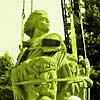
 The
bust of a young man crowning the sculpture represents the
Republic of Armenia’s newly established statehood. The youth’s
pose is directed upward creating an impression of him trying to
shake off the fetters that restrain him and embarking on the road
towards maturity and success. This is a collective image representing
the Armenian nation’s undying will to win its struggles, its
dedication and its perseverance. The young man’s image can
be interpreted as that of Vahagn, God of Victory in pre-Christian
Armenia, or of David of Sasun or Mgher Junior - all famous
characters of the Armenian folk epics. The
bust of a young man crowning the sculpture represents the
Republic of Armenia’s newly established statehood. The youth’s
pose is directed upward creating an impression of him trying to
shake off the fetters that restrain him and embarking on the road
towards maturity and success. This is a collective image representing
the Armenian nation’s undying will to win its struggles, its
dedication and its perseverance. The young man’s image can
be interpreted as that of Vahagn, God of Victory in pre-Christian
Armenia, or of David of Sasun or Mgher Junior - all famous
characters of the Armenian folk epics.
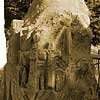
The young man’s bust is firmly seated atop the base of the
monument, on the perimeter of which a series of bas-reliefs symbolically
depicting events and personalities that shaped the identity and
the spirit of the Armenian people are carved.
 The
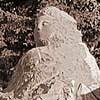
figure of the woman breast-feeding her famished child, which
occupies the frontal side of the sculpture, symbolizes the most
tragic point in Armenia’s history, the Genocide of the Armenians
in the Ottoman Empire. The mother is barely alive, but she defies
death. Her last wail seems to be a cry for justice denied for over
a million and a half Armenians massacred in 1915-1923. Her strong
arm seems to begin an upward swing, demanding rather than asking
for justice. The bas-relief is oriented to the east, and the figure
of the mother with the child comes to life every time the morning
sun’s beams touch it. The
figure of the woman breast-feeding her famished child, which
occupies the frontal side of the sculpture, symbolizes the most
tragic point in Armenia’s history, the Genocide of the Armenians
in the Ottoman Empire. The mother is barely alive, but she defies
death. Her last wail seems to be a cry for justice denied for over
a million and a half Armenians massacred in 1915-1923. Her strong
arm seems to begin an upward swing, demanding rather than asking
for justice. The bas-relief is oriented to the east, and the figure
of the mother with the child comes to life every time the morning
sun’s beams touch it.
 Still
on the east-oriented side of the monument, a tulip representing
the city of Ottawa is portrayed. That symbol not only epitomizes
the great capital city of Canada where the Armenian Embassy and
the monument are located, but also celebrates the Armenian-Canadian
connection through a flower that became the trademark of Malak Karsh,
the great Canadian photographer of Armenian extraction. It was largely
thanks to Mr. Karsh’s brilliantly artistic images of tulips,
that the flower has become synonymous with Ottawa. Still
on the east-oriented side of the monument, a tulip representing
the city of Ottawa is portrayed. That symbol not only epitomizes
the great capital city of Canada where the Armenian Embassy and
the monument are located, but also celebrates the Armenian-Canadian
connection through a flower that became the trademark of Malak Karsh,
the great Canadian photographer of Armenian extraction. It was largely
thanks to Mr. Karsh’s brilliantly artistic images of tulips,
that the flower has become synonymous with Ottawa.
 Armenia
is the first Christian State in the world. As children of the first
Christian nation, Armenians have carried their faith proudly Armenia
is the first Christian State in the world. As children of the first
Christian nation, Armenians have carried their faith proudly  and
with great dedication through centuries of trials and tribulations.The
depiction of a cross completes the frontal face of the monument.
Faith has historically been the sword of our self-defense, and the
sword of our self-defense has always been our faith. Hence, the
cruciform sword carved right next and
with great dedication through centuries of trials and tribulations.The
depiction of a cross completes the frontal face of the monument.
Faith has historically been the sword of our self-defense, and the
sword of our self-defense has always been our faith. Hence, the
cruciform sword carved right next  to
the cross. Underneath the cross and the sword, small statuettes
depicting Jesus Christ, Virgin Mary and Gregory the Illuminator
(Father and Patron Saint of the Armenian Church) are placed
in three stone alcoves. to
the cross. Underneath the cross and the sword, small statuettes
depicting Jesus Christ, Virgin Mary and Gregory the Illuminator
(Father and Patron Saint of the Armenian Church) are placed
in three stone alcoves.
 On
the northern side of the monument, a figure of Noah can be
seendescending Mt. Ararat. The dove in his outstretched hand represents
peace and symbolizes a new beginning On
the northern side of the monument, a figure of Noah can be
seendescending Mt. Ararat. The dove in his outstretched hand represents
peace and symbolizes a new beginning in life. The tree at Noah’s feet is the Tree of Life
with rootsreaching down to the very bedrock of history.
in life. The tree at Noah’s feet is the Tree of Life
with rootsreaching down to the very bedrock of history.
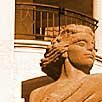
A young boy playing the Armenian flute, sring, is depicted
on the  western
side representing the creativity, vitality and diligence of the
Armenian people. Nearby, the depictions of a pomegranate
and a cluster of grapes carved side by side, are not only
the traditional Christian-Armenian images, they stand for unity
and connote the “one family, one entity” concept. western
side representing the creativity, vitality and diligence of the
Armenian people. Nearby, the depictions of a pomegranate
and a cluster of grapes carved side by side, are not only
the traditional Christian-Armenian images, they stand for unity
and connote the “one family, one entity” concept.
 The
pomegranate is split in half, and its numerous pits are spilling
out. They symbolize the Armenians spread all over the world. The
wound on the pomegranate is yet to heal. The
pomegranate is split in half, and its numerous pits are spilling
out. They symbolize the Armenians spread all over the world. The
wound on the pomegranate is yet to heal.
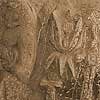
 The
eagle with his wings spread wide depicted at the back of
the monument is the symbol of the past glory of our people
and its freedom-loving soul. Just above the eagle, the symbol of
Canada, the maple leaf, is carved in the stone in appreciation
of this country for giving shelter to thousands of Armenian refugees
in the early 1920s. The
eagle with his wings spread wide depicted at the back of
the monument is the symbol of the past glory of our people
and its freedom-loving soul. Just above the eagle, the symbol of
Canada, the maple leaf, is carved in the stone in appreciation
of this country for giving shelter to thousands of Armenian refugees
in the early 1920s.
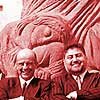
The monument is created by a prominent Armenian sculptor, Levon
Tokmajyan and his talented son, Hayk, at the initiative of the Embassy
of the Republic of Armenia in Canada. The expenses associated with
the building of the monument were covered thanks to generous donations
by numerous individuals and organizations of the Armenian-Canadian
community. The names of all donors have been recorded in two identical
commemorative journals to be kept at the Armenian Embassy in Ottawa
and in the Museum of the Armenian Genocide at Tsitsernakaberd in
Yerevan.
The height of the monument is 300 cm (without the base), the perimeter
at the base is 500 cm. It is carved out of a monolith Armenian orange
tufa, which was shipped from Armenia in October 2001. The monument
weighs almost 6 tons. Armenia Immortal is the largest sculpture
ever made of a single piece of tufa outside Armenia. A trilingual
inscription cast in bronze is mounted on the base. It reads:
Armenia
Immortal
Sculptors: Levon and Hayk Tokhmajians
Ottawa, 2002
In tribute to Armenia, as symbolized by Mt. Ararat, and to the Armenian
people, who were the first to embrace Christianity in 301, and the
first nation to be crucified in 1915-1923, falling victim to the
first genocide of the 20th century.
For the glory of a reborn free Armenia, whose sons and daughters,
despite their ancestral suffering, continue to believe in justice.
|